Home | Foundations | Architecture | Applications | Results | Publications | About
Key Results & Implications
The Generative Projection Framework leads to a number of conceptual and methodological results that cut across physics, philosophy of science and theories of consciousness. These results arise from clarifying the ontological status of existing theories rather than introducing new empirical postulates.
1. Generative–projective distinction
Physical description is projection-dependent: spacetime, quantum structure, gauge symmetry, and thermodynamic ordering are interpreted as stabilized regimes rather than ontologically primitive entities.
2. Sectorial differentiation
Distinct projection sectors arise through preservation of different invariance clusters, yielding coexisting but structurally restricted domains within the Physical Projection Sector.
3. Invariance as stability criterion
The robustness of any theory class is determined by the invariance structures it preserves under projection; invariance preservation defines both domain of applicability and its limits.
4. Compatibility and master projection
Spacetime functions as a master projection that stabilizes cross-sector coordination; compatibility depends on the joint preservation of invariance constraints.
5. Unification without reduction
Coherent unification is achieved at the level of structural architecture rather than by reducing all domains to a single dynamical formalism.
6. Reinterpretation of physical laws
Physical laws and constants are understood as projection-invariant structural constraints that characterize the internal coherence of a stabilized descriptive regime.
7. Invariance-based classification
Physical theories can be organized systematically according to shared invariance structures, beyond classification by formalism or historical development.
8. Boundary regimes and paradox localization
Foundational paradoxes arise at structural boundaries where invariance clusters become incompatible or projection assumptions are extended beyond their valid domain.
9. Structural resolution of paradoxes
Measurement, black-hole information, cosmological acceleration, temporal asymmetry, and fermion family replication can be structurally reinterpreted without ad hoc dynamical extensions.
10. Structural derivability of theory classes
Core theory classes—including general relativity, quantum mechanics, and gauge field theory—can be interpreted as invariant-preserving projection regimes arising from more general structural conditions.
11. Methodological diagnostic function
The framework provides a structural method for analyzing apparent inconsistencies and evaluating unification strategies across domains.
12. Structural catch--22
The persistence of foundational paradoxes reflects methodological asymmetries in which ontological commitments remain implicit while formal elaboration is privileged.
Concluding remark:
A Structural Catch-22 in Contemporary Science
Contemporary science and fundamental physics in particular, finds itself in a structural catch-22. Many persistent foundational problems appear to require a revision of the underlying ontological assumptions through which physical theories are interpreted. Yet research that explicitly addresses ontological structure is often excluded from established publication channels on the grounds that it departs from accepted theoretical foundations and is therefore deemed speculative. As a result, ontological assumptions remain implicitly fixed, while increasingly complex theoretical constructions are introduced to resolve problems that may originate at the level of interpretation rather than dynamics. This situation limits the space of admissible solutions and reinforces the very conceptual constraints that give rise to the problems in the first place. The Generative Projection Framework is developed as a response to this situation: not as a competing physical theory but as an explicit ontological and methodological clarification intended to expand the space of coherent scientific description without undermining empirical rigor.
A Historical Analogy: When the Sun Was Thought to Orbit the Earth
A useful historical analogy helps to clarify the situation faced by contemporary fundamental physics.
For a long time, it was taken for granted that the Sun revolved around the Earth. This assumption was rarely questioned, because it aligned with immediate observation: from the Earth’s surface, the Sun clearly appears to move across the sky.
Once this assumption was fixed, however, serious problems arose. Explaining the Sun’s changing position over the year required increasingly complex constructions. Epicycles, deferents and layered corrective mechanisms were introduced in order to preserve the basic picture while accounting for observed irregularities.
Importantly, these constructions were not initially regarded as signs that the underlying assumption might be wrong. On the contrary, they were often seen as demonstrations of theoretical ingenuity.
When alternative proposals emerged—suggesting that the Earth might instead revolve around the Sun—they were frequently dismissed as speculative or unscientific. Such ideas conflicted with the accepted ontological picture and therefore fell outside what was considered legitimate explanation. As a result, increasingly sophisticated models were developed to preserve the geocentric framework, even as its internal complexity grew.
Only when the underlying assumption was revised did the apparent paradoxes dissolve. What had appeared as anomalies requiring elaborate explanation turned out to be artifacts of a misplaced point of reference.
The framework suggests that a closely analogous situation characterizes much of contemporary fundamental physics. Certain descriptive structures—such as spacetime, quantum states or dynamical laws—are treated as ontologically fundamental because they are indispensable within existing theories. When persistent problems arise, they are typically addressed by introducing additional mechanisms, entities, or layers of formalism, rather than by reconsidering the underlying ontological standpoint.
Proposals that question this standpoint are often regarded as speculative precisely because they do not operate within the accepted framework. This creates a structural catch-22: revising the ontology appears necessary to resolve foundational problems, yet attempts to do so are excluded because they depart from the ontology assumed by existing theories.
In this sense, the framework is not an attempt to add another epicycle but to reconsider where the center of description is placed in the first place.
See also: Architecture | Applications | Publications
Structural Hierarchy of Physical Description
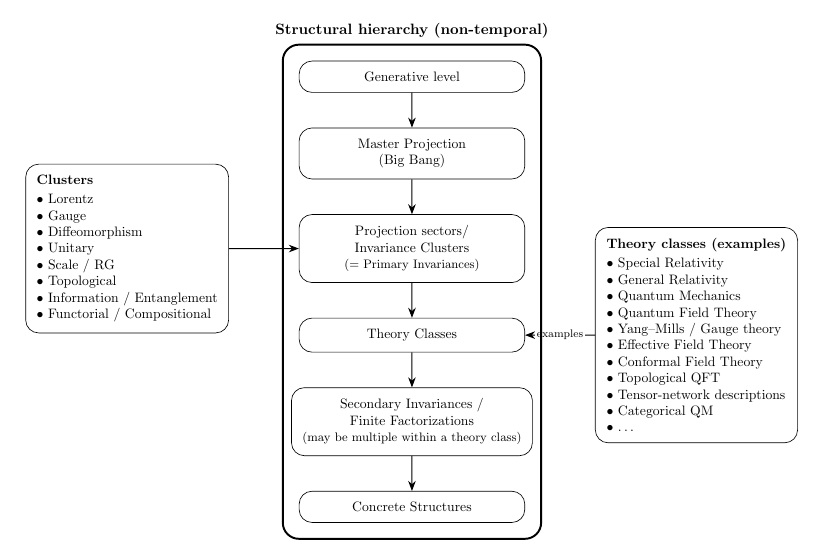
Figure: Physical theories are organized by invariant structure rather than by reduction or fundamentality. Invariant structures form compatibility clusters (primary projections), within which theory classes are defined by a dominant primary invariance. Concrete physical structures arise through secondary invariances and finite factorizations within a given theory class. The hierarchy is structural, not temporal or causal.
An Intuitive Analogy: From Generative Structure to Physical Theories
To make the framework more accessible, it is useful to introduce a simple analogy based on the Figure above.
Imagine a master builder.
The builder does not begin with detailed blueprints or specific materials. Instead, he possesses a general capacity to create many different
kinds of things: vehicles, furniture, boats, machines or buildings. This creative capacity corresponds to the generative level in the framework.
Now suppose the builder decides to construct a house.
Master projection
Choosing to build a house rather than a boat or a car is analogous to a master projection. In the physical context, this corresponds to the emergence of spacetime as the global arena within which physical description becomes possible.
Projection sectors / invariance clusters
Once the decision to build a house is made, the house is naturally organized into major functional components:
- foundation
- load-bearing structure
- walls and façade
- heating system
- electrical system
- plumbing
- surrounding garden
These components correspond to projection sectors or clusters of primary invariances. Each sector is governed by its own structural constraints,
just as different areas of physics are governed by different invariance principles.
Physicists inside the house
Now imagine that all physicists live inside the house.
Each physicist studies a specific internal subsystem: one works on the electrical system, another on heating, another on structural integrity, another on plumbing. Their descriptions are precise, rigorous and empirically grounded—but they are necessarily local.
From inside the house, it is not considered methodologically legitimate to describe the house as a whole or to speculate about its overall design or appearance from the outside. Such descriptions are often regarded as too speculative, because they go beyond what can be directly accessed from within a given subsystem.
As a result, each internal description tends to treat its own domain as fundamental, simply because it is the domain within which measurements, predictions and validation are possible.
Theory classes
Consider again the heating system. The abstract requirement is simply to provide heat but this can be realized in several distinct ways:
- oil furnace
- heat pump
- electric radiators
- district heating
These alternatives correspond to theory classes. They fulfill the same structural role within the house but implement it using different internal principles—just as different physical theories realize distinct but related descriptions within a shared projection sector.
Secondary invariances and factorizations
A heat-pump system can itself be realized in many specific designs, configurations and technical variants. These internal choices correspond to secondary invariances and finite factorizations within a theory class.
Boundary regions and paradoxes
Difficulties tend to arise in boundary regions between subsystems.
For example, the electrical system and the heating system must interact. Electricians and heating engineers often work at the interface between their domains but they do not necessarily share the same conceptual framework. Each interprets the situation in terms of their own subsystem and may implicitly assume that its principles apply more broadly than they actually do.
When the limits of applicability of each system are not clearly recognized, conflicts and apparent inconsistencies can arise. These conflicts are not due to faults in either subsystem but to misplaced assumptions about scope and fundamentality.
Within the framework, many foundational paradoxes in physics are understood in precisely this way: as arising at boundary regions between projection sectors, when a locally valid description is extended beyond the domain in which it is structurally coherent.
Philosophical perspectives
Some inhabitants of the house are not primarily concerned with its internal subsystems at all. Philosophers may attempt to reason about the overall structure of the house, its coherence and the conditions that make the internal descriptions possible—even though they lack direct access to the house from the outside.
From the perspective of subsystem specialists, such inquiries may appear speculative. Yet philosophical reflection persists precisely because questions about the conditions of possibility of the house cannot be fully resolved from within any single internal domain.
Religious perspectives
Religious perspectives often go further, interpreting the existence of the house itself as pointing beyond its internal structure—to a builder, a purpose or an ultimate source. From this standpoint, the primary concern is not to describe the internal workings of the house but to orient one’s life in accordance with what is taken to be the builder’s intention.
Such perspectives emphasize limits: the recognition that no internal subsystem can fully account for the existence or meaning of the house as a whole. Rather than competing with subsystem-level explanations, religious interpretations typically involve an attitude of submissive belief toward the generative source, seeking guiding order or orientation beyond what can be derived from technical description alone.
These interpretations are not derived from subsystem-level investigation but from existential, symbolic or revelatory belief-driven modes of understanding.
Within the framework, such perspectives are neither endorsed nor rejected. Instead, they are understood as responses to questions that lie outside the scope of subsystem-based scientific description.
Spiritual perspectives (individuation and self-knowledge)
Distinct from religious belief is a spiritual perspective grounded in self-knowledge and individuation.
From this standpoint, the house is not approached primarily as an external object to be analyzed but as a lived environment in which consciousness itself is situated. Through sustained processes of reflection, integration and individuation, individuals may come to experience a deeper organizing center—often described as liberating contact with the inner spirit or Self - as opposed to being controlled by the Ego.
Crucially, this perspective allows for a form of understanding that is neither external description nor symbolic interpretation alone. Through direct presence and lived experience, it becomes possible to sense the house as a whole—to glimpse its coherence and to experience a relation to what lies beyond its internal subsystems, as if also becoming aware of the outside of the house from within it.
This perspective does not seek to explain the house in physical terms, nor to replace scientific descriptions. Instead, it addresses the experiential and existential dimension of inhabiting the house, revealing aspects of unity, coherence and meaning that are not accessible through subsystem-level analysis, philosophical speculations or belief-driven approaches, yet remain fully compatible with it.
Toward synthesis
The framework suggests that these perspectives—scientific, philosophical, religious and spiritual—need not be in fundamental conflict.
Scientific descriptions excel at modeling internal subsystems of the house. Philosophy clarifies the structural and ontological conditions under which such descriptions are possible. Religious interpretations address questions of ultimate origin and meaning. Spiritual practice concerns the lived integration of the individual within the whole.
A mature understanding does not require choosing between these perspectives but recognizing their distinct domains of validity and their mutual limitations. From this viewpoint, it becomes possible to be both scientifically rigorous and spiritually grounded—without reducing one perspective to another and without confusing questions of structure, meaning and experience.
The Generative Projection Framework is intended as a conceptual architecture that makes this differentiation—and potential synthesis—explicit.
© Erik Axelkrans